Jun 20, 2011

Streicher und Sohn - Gerrit Zitterbart and others

Streicher und Sohn - Gerrit Zitterbart and others


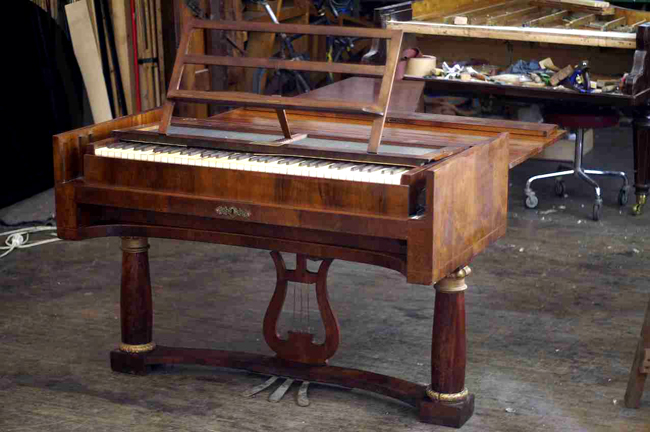
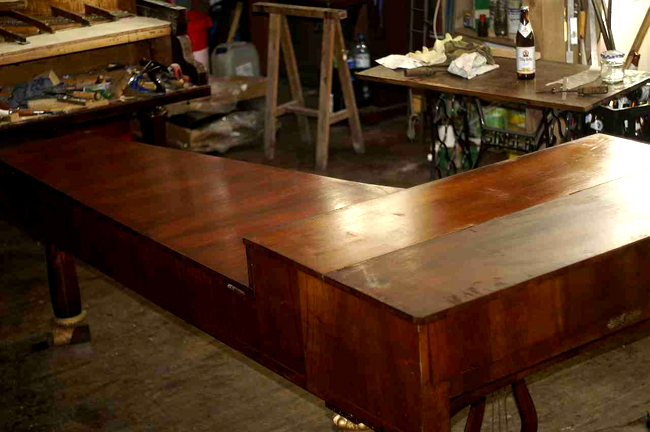
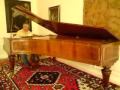
Some informations and surroundings about the downstriking "Nanette Streicher und Sohn" grands;
surely one of the most expensive grands about 1825 and surely the state of art then.
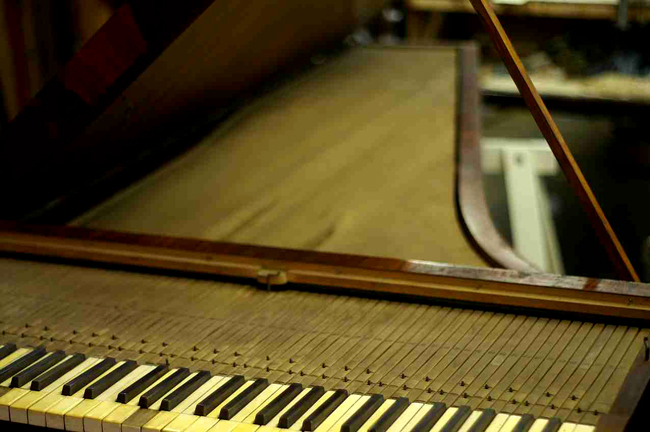
As the strings are running the full length of the instrument until under the keys this type of instrument has remarcably longer strings than a conventional grand of similar length. 

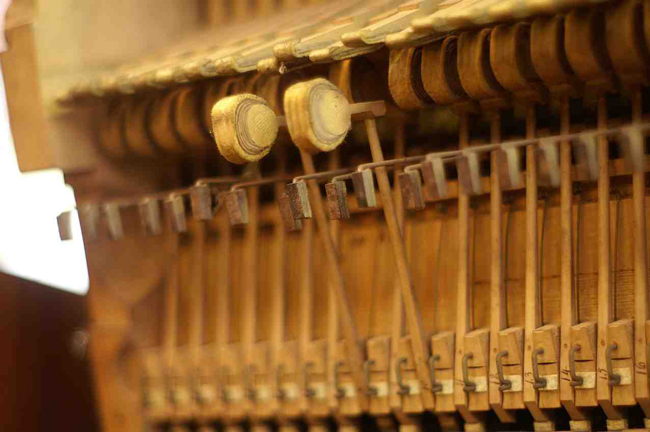
Apart of the dimension theoretically it is much better to knock the hammer onto the string pushing it to the soundboard than hitting the string from underneath lifting it ...
Practically this mechanism was too expensive to be sold numerously but the sound still is incomparable.

The downstriking viennese action works with 5-6 mm way of the keys, a completely different feeling, but I doubt I can describe it properly by words.
We have to consider these instruments travelled by coach to their most aristocratic customers.
In case you can provide any information about previous or actual owners or locations or in case you know further instruments please send a Mail
- - -

On 10. January 2009 Gisela informed me on a friends birthday-feast she had been in a concert in Bielefeld at Villa Hülsmann where was played a Streicher-grand.

I asked whether she were sure, as I did not know such Instrument in Bielefeld.

She insisted, Streicher und Sohn indeed, played by Gerrit Zitterbart.

I replied: "That Gerrit Zitterbart from Göttingen?"

- - -

The next day I was at Villa Huelsmann to see that instrument, could hardly trust my eyes and could purchase at least the famous CD of Gerrit Zitterbart, playing Schubert D 960 Sonata on this very grand.

Just half a year before I unsuccessfully tried to contact Mr. Zitterbart as I had been informed he were a specialist for historic performance ... and as he teaches at Hannocer and I had a serious question about a square piano from Bornemann, Hannover, I searched for information trying to ask him.

But things came different, when I was at Kloster (monastery) Michaelstein near Blankenburg, visiting the piano collection there a saturday-afternoon.
Somebody came in and freely tested a piano there, another too, and so on and I kept in background for not disturbing him as I guessed he were as frightened as me to touch the instruments ...

Finally I watched closer and had some idea of deja vue and asked after introducing me: "Are you Mr. Zitterbart?" He replied: "Yes".

I mentioned my desire for information about Bornemann and asked happily what he were doing this afternoon at Blankenburg.

A concert in the evening was to be given and so he was there to test the instrument before (or to warm up) and before this he took advantage of the opportunity to visit the collection.

He encouraged me to come with him while he were testing the instrument and this way I had evenings concert in the afternoon, but twice and with opportunity to ask ...

I told him about the missed concert in January and it was sure I were present next occasion.

So on  2nd January 2010 I was able to listen to the Streicher und Sohn grand in Bielefeld the first time in "nature" ...
in the famous recording of Burkhard Scheibe

On this occasion I was kindly permitted to come sooner and could hear not only the concert partly in advance, but the most charming moments where when Gerrit Zitterbart and Burkhard Scheibe happily discussed the performance of the Streicher-grand, while trying the instrument alternating. I will ask once more whether I probably may put in probably here this very dialogue, but I perfectly understand professional pianists aren't that keen on everybody hears them in the internet but doesn't buy their CD's.
Let me use this occasion to remind you there are CD's for sale directly..
I purchased most of them and feel happy to hear them quite often.. Just after the Schubert D 960 - in two versions, one the famous Streicher and the other version a Bösendorfer Imperial - I love most the Beethoven Frühlingssonate (spring sonata) and I could hardly tell you which version I like better; it depends on the mood and I alternate often, listening to them over and over again ...

There is still the recording of the whole concert of 2.1.2010 at last wave Studio and I seriously hope to be able to buy it as a film, not only as a CD one day. It is much more educative to have visibility to the whole situation. I mediate on how I could corrupt Burkhard Scheibe to do that job to create this masterpiece similar to that excellent post on youtube he gave us ...

Gerrit Zitterbart introduces his concerts with fascinating explanations about the instrument and the composer and informed his public there were about six grands of that type of Streicher still existent worldwide,
the whereabouts you may research on Tastenwiki, that special mechanism is called "oberschlägig" there ...

Sure, next year on 2.1.2011 I was present again, this time Gerrit Zitterbart played my beloved D960 from Franz Schubert.
This Grand was at Castle Bückeburg until about 1955,when it was bought and given to the city of Bielefeld as a gift; it was restored in Swiss and found its place at Museum Hülsmann after several years of storage in the concert hall of Bielefeld, the Oetkerhalle.

---

In the internet were traces about another exemplar, built 1825 with number 2288 of this very type of Streicher-grand, at Piano Salon Christophori , Berlin. 

After some contacts it was clear I had to go there; I feel ashamed I did not yet. At least there is some information visible here. Piano Salon Christophory collects and restores finest historic grands and performs concerts in the workshop by excellent pianist almost weekly. Christoph Schreiber and his Salon might will become s several post so here is the link to the Homepage of the Salon Chrostophori only.

---

A futher exemplar, Streicher No. 1980 is also well documented in Sweden in the Musikmuseet_Stockholm
Spring 2011 returning from Italy I passed Bad Berleburg, the location of another Streicher und Sohn grand, identical to that one at Bielefeld, but in worse condition. Unfortenately the preparations of the wedding (which took part this weekend, in June) of princess Nathalie were intense so nobody could give me opportunity to watch the instrument my way. I recected the opportunity of a normal public visit as I guess ist might be shocking when a visitor sinks under the instrument, watching underneath and so on ...
But as I researched in the internet in advance, I knew the sight I missed as an ordinary visitor.
Sight to the Streicher und Sohn grand at Bad Berleburg, Germany, foto from this link
I would like to express my sinceerest congratulations to the bridal couple on occasion and will announce in advance my next visit at Berleburg.
---

During researching again for this text appeared further information, there is another exemplar in North America. in the National Music Museum, South Dacota on the campus of the University of South Dacota, Vermillion.

here is the enclosed text:

NMM 10298. Grand piano by Nannette Streicher und Sohn, Vienna, 1829. Serial nos. 2316 (cumulative) and 136 (of this model). CC-f4 (6+ octaves). Three pedals: una corda, due corde, dampers. Downstriking action, patented by Johann Baptist Streicher in 1823. Purchase funds gift of Tom and Cindy Lillibridge, Bonesteel, South Dakota, 2003.

See the complete list of instruments at the university of South Dacota here

and see here the full description of that very Streicher und Sohn


- See the full article following here. This quotoation is only destinated for historic research.-


Images from the Study-Storage Collections

Grand Piano by Nannette Streicher and Son, Vienna, 1829


NMM 10298. Grand piano by Nannette Streicher und Sohn, Vienna, 1829. This immaculately preserved grand piano represents a glorious moment in the history of instrument making. When J. A. Stein died in 1792, his workshop was kept in operation by his daughter, Nannette (1769-1833), and her brother, Matthäus Andreas (1776-1842), known as André. In 1794 the siblings moved the business from provincial Augsburg to Vienna, where they worked together until 1802, when André set up his own workshop. Nannette, who in the meantime had married the pianist and composer, J. A. Streicher, is an extremely rare historical instance of a woman visibly in charge of a major business. Moreover, it is virtually certain that her role was not confined to the front office. She was actively engaged in the design and musical finishing of the instruments bearing her name.

NMM 10298. Grand piano by Nannette Streicher und Sohn, Vienna, 1829.


Downstriking action of grand piano by Nannette Streicher und Sohn, Vienna, 1829.

A radically redesigned new model with a downstriking action, of which the Museum's example is one of the earliest in existence and undoubtedly the best preserved, it was patented in 1823 by Johann Baptist Streicher (1796-1871), Nannette's son, the same year that he joined the firm as a partner. The Streichers maintained a long and cordial association with Beethoven, and the downstriking model, expensive to produce, was the top of their line.


The Streicher firm was one of the two or three most eminent in Vienna, arguably even the industry leader among the scores of piano makers, including A. M. Thÿm, who were active in the Imperial and musical capital.

Side view of grand piano by Nannette Streicher und Sohn, Vienna, 1829.


Embossed brass plate bearing maker's name.

Embossed brass plate bearing both the maker's married (Streicher) and maiden (Stein) names.

Label inside grand piano by Nannette Streicher und Sohn, Vienna, 1829.

Maker's label. Purchase funds gift of Tom and Cindy Lillibridge, Bonesteel, South Dakota, 2003.

  Click arrow to continue Study-Storage Collections Tour

Go to Study-Storage Collections Tour Index

Go to Virtual Tour Index

Go to Checklist of Keyboard Instruments

National Music Museum
The University of South Dakota
414 East Clark Street
Vermillion, SD 57069


©National Music Museum, 2003-2007


---

- Yokohama (Courtesy: Gerrit Zitterbart)

---

- One Exemplar should be at the Germanisches Nationalmuseum Nürnberg. (Courtesy Gerrit Zitterbart)
   English site of the  Germanisches Nationalmuseum Nürnberg

---

- One Exemplar should be at New York (Courtesy Gerrit Zittebrbart)

---
- Ludwig Maximilians Universität München (Munich)

Copyright Robert A. Brown
 - this and further fotos of this exemplar you may find here on the site of Robert A. Brown. It is exemplar No. 1977/19 and I would like to quote his description: "Veneered in exotic walnut. Compass: FF - f4. Three pedals (from left to right): una corda, due corde, damperlifter. This instrument belongs to the Department of Musicology, Ludwig Maximilian University, Munich. Restored in 2002"

---

Kunsthistorisches Museum Wien, Baptist Streicher, 1840

as the above link is not working properly, following here I post the original text from the  Kunsthistorisches Museum Wien:, hoping to be permitted to do so.

At least here I try to post their direct Link once again:
http://www.khm.at/

Johann Baptist Streichers (1796-1871) Klavierfabrik war bis zu ihrer Auflösung im Jahr 1896 zusammen mit der Firma Bösendorfer die bedeutendste im

Hammerflügel mit oberschlägiger Mechanik

Johann Baptist Streicher | 1840
Johann Baptist Streichers (1796-1871) Klavierfabrik war bis zu ihrer Auflösung im Jahr 1896 zusammen mit der Firma Bösendorfer die bedeutendste im österreichischen Raum. Die Grundlage dafür waren nicht zuletzt Streichers großes technisches Verständnis und sein Streben nach Perfektion. Er nahm zahlreiche Verbesserungen vor, die teilweise nur Details, teilweise aber auch grundlegende Konzepte betrafen. So erkannte er beispielsweise, dass der Hammeranschlag von oben eine bessere Übertragung der Energie von der Saite auf den Resonanzboden bewirkt. Er entwickelte die so genannte oberschlägige Mechanik, die nach diesem Prinzip funktioniert. Die klanglichen Ergebnisse gaben ihm zwar Recht, die Wartung der Mechanik dieses Typs und der Stimmvorgang erwiesen sich aber als zu kompliziert.

Literatur:
Julius Schlosser: Die Sammlung alter Musikinstrumente. Beschreibendes Verzeichnis, Wien 1920.
Victor Luithlen: Kunsthistorisches Museum. Katalog der Sammlung alter Musikinstrumente. Teil 1. Saitenklaviere, Wien 1966.
Rudolf Hopfner: Meisterwerke der Sammlung alter Musikinstrumente, Wien 2004.


---
Some research (links)


The article about Nannette Streicher appeared in Continuo, an early music magazine which has ceased publication, in May and June 1986. © Margaret Hood 1998

An article in german about research on the used wood. 

Article in german about the instruments of Germanisches Nationalmuseum Nürnberg

An article on the Streicher Family from Piano An Enzyclopedia

The piano (Google books)

German Piano Collections (article)

research on the word "hammerklavier" on domenica.net

Makers of the Piano: 1820-1860 - Google Bücher-Ergebnisseite

Piano actions - OoCities

Performance practice: a dictionary-guide for musicians - Google Bücher-

The Check in Some Early Pianos and the Development of Piano

Throughout the nineteenth century the Streicher family was one of the most ... Johann Baptist PATENTED a workable downstriking action (1823) in which the ...

  Grand piano with downstriking action, Johann Baptist Streicher, Vienna, 1837. (No. 2991). Compass CC-g"". 1823 invented downstriking Viennese action. ...


many thanks to all persons who have contributed somehow to compose this puzzle


To be continued

Jun 19, 2011

Martin Dalheimer

Some day I found in the internet researching on square-pianos a remarkable post:


Somebody played "Recuerdos della Alhambra" of Francisco Tarrega - on a Broadwood square piano from 1830.
I knew this were impossible, as the escapement should prohibit such rapid repetition, or at least I suspected.


But I listened:


I had to find out why this were possible, apart from the fact I like Recuerdos very much and so I researched, sent some messages and received a kind reply most quickly. We had some contacts by mail and telephone and after easter 2010 I dropped in at his house returning from Italy.


We spent some hours as I neglected the fact I had to return home soon and I found out that he had regulated his piano in his very personal way, this way avoiding the escapement would prevent very, very rapid repetitions. I came home very late by night having to work in the morning ...


Some months later they came to visit us. But that is worth a different story.


First I would like to give you the link on broadwood1830

and on the Homepage of Martin Dalheimer


Following here I post some links on Martin , possibly quoting the original comments

Martin Dalheimer is playing the Erard Grand in the Church of Eutin. Eutin was the birthplace of Carl Maria von Weber. He is very well known for his opera "Der Freischütz" but his less known piano-pieces are filled with beauty, virtuosity and technical raffinesse.

Chopin Opus 72 c-moll
Martin Dalheimer is playing one of Prof Beurmanns famous pianos in Hasselburg. It is a Hüni and Hübert made in 1860 in Zürich.

Martin Dalheimer is playing Chopin Opus 9 No 3 on a historical grand from 1860 of Prof. Andreas Beurmanns collection. It's a Hüni and Hübert from the wellknown Zürich pianomaker.


Martin Dalheimer is playing a Broadwood grand from 1841 in the Museum für Kunst und Gewerbe Hamburg. The collection there includes about 400 pianos and cembali inclusive the Andreas Beurmann pianos. This broadwood grand belongs to Max Matthias and is dated to 1841.
Martin Dalheimer is playing.
1. Chopin Opus 72 e-moll
2. ChopinOpus Posthum cis-moll
3. ChopinOpus 27 No 2


Chopins humorous waltz in memory to his time he spent in vienna. It´s a persiflage on Viennas lifestyle where Frédéric Chopin was not able to get the consideration he wanted. Second time Vienna has been a great disillunsion for the young composer and musicain. Nobody wanted to hear him, nobody wanted to print his scores. So he did this wonderfull persiflage on viennas modern music in the early 19th. century: the waltz

There is a surprising discussion in some internet-places about the style not only this jewel is interpreted by Martin Dalheimer.
Martins rubato is remarkable; the rubato since the beginning of the 1900... was almost abandoned and not many pianists can do rubato - may I call it the "real rubato"? -  any more , or even if they can, only few do. 
The explanation of this piece astonished me and since then I heared this op.18 with more fun and better understanding.
I do not care for some gellous critics ...


Martin Dalheimer had a workshop in the Piano-atelier Olivier Fadini in Paris. Olivier is on best condition to find the real Chopin sound. He works with several Pleyel Pianos. Also with a Pianino Chopin liked so much. After intonation of the Hammer-heads Martin Dalheimer performed well known Opus 9 No 2 with unusual ornamentic like Koczalski did about 100 years ago.


Chopin Opus 55 No 1 On a workshop in the famous piano atelier of the genius Olivier Fadini in Paris, Martin Dalheimer plays on a Pleyel Pianino. Sorry for the Quality of recording.
But you can hear, how Opus 55 No 1 works with rubato.


This Video is made in the pianobuilder atelier from the genius Monsieur Olivier Fadini in Paris.
Martin Dalheimer is playing John Field Nocturne No 2, 6 and 3 on a Pleyel Pianino from 1837. It's hammerheads are covered with felt, so the sound is really warm and mystery. This kind of piano has been prefered by Chopin. During his life he posessed a lot of them like Mr. Jean-Jacques Eigeldinger showed in his new book about Chopin and Pleyel.


Martin Dalheimer if neccessary also repairs and tunes pianos so in ghe following links you can see a Broadwood cottage upright beeing tuned
Tuning 1
Tuning 2
Tuning 3
Opus 72 c-moll on Cottage Upright Until 3 p.a. tonight Martin worked on Broadwood Cottage upright piano. Today in the morning the piano had it's premiere after rising again.
So Martin first played Chopins Nocturne Opus 72 c-moll.
With best regards to Gilles

Chopin Opus 9 No 1 on Cottage Upright This is one of the best known compositions from Frédéric Chopin. Most time you can hear it palyed in a romantic slowly kind. But the expression of this little music-piece will come closer if it is played in original tempo. Martin told me any minutes ago that playing this piece on the upright cottage piano from 1844 is very different to plaing it on his square piano. The use of „real rubato" is much easier on this piano. Hands work togehter and against each other naturally. plaing real rubato is not as difficult as on another piano. So there comes the question why it is so.
I think it belongs to the fact, that the strings in this piano didn't cross. It is allover double stringed. And the strings grow up straight vertically. So the tone can be built without any obstacle without interferences which are built if two strings cross.
At least we can say: yes this piano gives us a clear imagine how Chopin worked. It makes possible to understand his instructions how to play...
Today there are a lot of people who tells us, tempi are not possible to play Chopins tempi based on a wrong time and so on. A lot of people take modern pedaling by plaing Chopin. But the piano like Chopin played had no so such Pedals. But therefore they had a una corda pedal which changes tone heavy. It is perfect for some interesting effects by playing Chopin. Although the other pedal which shortens the way of Hammer. it makes a dry, clear, fine tone. So we hope that it will be possible to find more people who want to take care of the rare instruments of the 19th century which are not tuned and restored on todays taste.
One day we will find a Pleyel upright piano and an Erard upright piano and although one of Broadwood again to compare and learn how Chopin really played.

Frederic Chopin Opus 28 No 15

The raindrop prelude Frédéric Chopin wrote down in Mallorca in the monastery of Valldemosa. The weather was windy and stormy, the rooms dark and cold overlaid from creepy silence. The housclaks have always stolen foods and never done their work satisfactory. And then there it was always raining. So Chopin may be influences by all this in composing the prélude Opus 28 / 15. The so called raindrop-prélude. So called by George Sand. She said it seems to hear the Raindrops fallen down from roof to the ground. Chopin reacts with a little annoy. He said this interpretation is very childish. And not engough George added to her first description: The prélude he wrote down on this evening was filled of raindrops, which resounds on the clinking bricks; in his own fantasie and in his singing Raindrops changed into tears falling down from heaven to his heart.
This is all a trying to explain with romantic words a composition without a lot of romance. I think, Chopin would show the piano players that it is possibel to change left and right hands work. So here you find the right hand giving rythm, speed and basics. Left had is playing a sometimes sweet and othertimes obtrusive melody which includes pain, love, and joy of life.


Today, June 2011 I found the information that Martin put some new videos to youtube from his most recent journey to Austria:

As it is so beautiful I would like to quote the original comment in german and translate it afterwards:

Kurzbesuch in Wyregg im privaten Piano-Museum von Jörg Demus, dem Museo Cristofori. Neben vielen anderen erlesenen Instrumenten hatte es Martin besonders der wunderschöne Wiener Bösendorfer-Flügel angetan. Wunderbar für Martins Spielweise. Der Liebestraum entstand ganz spontan, nachdem Martin Dalheimer den Flügel erstmals angefasst hatte. Jörg Demus hat hier ein Märchenschloss für musikbegeisterte Menschen geschaffen, das in einem tiefen Dornröschenschlaf zu liegen scheint. Die wunderbaren Instrumente in ihrer traumhaften Umgebung möchten nur eines: gespielt und gehört werden.  

Short visit at Wyregg in the private piano-museum of Jörg Demus, the musei, Cristofori. Beside of many other most precious instruments Martin was attracted by a terrific viennese Bösendorfer grand. The "Liebestraum" arose spontaneously, immediately after Martin touched the grand the first time. Jörg Demus here created a castle from the fairy tales for the public loving the music which seems to be fallen in a deep sleep. The miraculous instruments in this dreamlike ambiance seem to desire only this: To be played on and to be listened to.

Martin Dalheimer zu Besuch bei Anton Wille im Flügelhaus Ernst Gröschel im Kaunertal in Österreich.  (Tel. 0043 676 6382477 (14.00 - 18.00 °clock GMT-1)

At Kaunertal in Austria met  Ernst Gröschel in memoriam, Martin Dalheimer as a student of Ernst Gröschel and the friend Anton Wille to speak and to play music.
There lay around the preludes of Rachmaninov, and the tuning of the grands were still these Ernst Gröschel gave them over 10 years ago. Spontanously Martin played from the score, not concertant, on this beautiful Bechstein grand..
Toni Wille here created his own paradise where he created the only memorial-location to Ernst Gröschel, the extraordinary pianist. Through Gröschels influence Wille started to collect grands, from Gröschel he learned to tune and much about sound and sound-development. He lives and maintains Ernst Gröschels Heritage and by the way he creates his own works: Kornkreise, cut in wood to keep these messages in the memory of mankind.

- - -


Martin Dalheimer studied at Ernst Gröschel. This might become a separate post..

 
Probably you detected this post were an almost complete quotation of the whole youtube account of Martin Dalheimer, but I assure you I have chosen only the pieces I like best .... 

Martin Dalheimer is one of the few pianists performing on a genuine historic instrument. He also comes with his instrument in his car on demand and performs his superb concerts in your location. His Broadwood square piano is a fine, well preserved  example of  popular instruments from about 1830. Sure, such instument won't fill big halls with sound and public and the sound is different to nowadays ears. The sound is percussive and brilliant, rich of overtones and may be that sort of sound the composers expected when composing their music. I regret, Martin lives 400 km distant from my home but I am happy I have opportunity to experience that sort of concert here and there again

International Music Score Library

Hauptseite (Home, german)

Main_Page


Tastenwiki

Tastenwiki is a highly recommended german source
to research or contribute about piano-makers.


Tastenwiki Home


Archive of fotoes


Das_virtuelle_Museum_Fortepiano_Bartolomeo_Cristofori


piano-collections worldwide

Virtual Museum


The virtual collection of fortepiani here, linked as playlists on youtube is an attempt to create a collection of links to predominantly historic fortepiani. This might support research of the character of sound and construction and maybe localization and contact. Please feel free to contribute.

==Collection==

List of links to facilitate finding historic Pianos and registrations on them in the web


Playlists to (mostly) historic pianoforti (fortepiani); these will be sorted later on somehow.


Not only sorted by composer, but also by pianist or something else of my interest in alphabetical order
... and might never be finished ...

Many thanks and best regards to all the users who contribuited their treasures and to those who will.


Have pleasure. Any suggestions welcome.
Best regards again and again.

nuclear


http://www.youtube.com/user/WannWennNichtJetzt

Weihnachten bei Hoppenstedts ( Christmas at the Hoppenstedt-family) is the collective name of a series of scetches of Loriot (Vico von Bülow) Loriot. The first broadcasting was on 7. december 1978 at german Radio Bremen (ARD)

Description

(german original)
In the toys-shop 
Grandpa Hoppenstedt joins the toys-shop to look for a christmas gift forseen to his grandchild Dicki. But, after he could not tell the salesclerk neither the sex nor the age of his grandchild, the clerk recommended the model-kit Wir bauen uns ein Atomkraftwerk (We construct a nuclear power plant) the model of a nuclear power plant to build at home, what creates „Puff" in case during construction an error occurs.


Weihnachten bei Hoppenstedts (Christmas at the Hoppenstedt-family)

(german original)
On christmas evening ...    
Daddy Hoppenstedt builds the Christmas-gift of Dicki, while Dicki is sitting silent in a corner. But the power plant makes „Puff" and cracks a hole into the floor, not causing for fun at the neighbours below. While Dad and Mother Hoppenstedt tidy up the wrapping papers, grandpa Hoppenstedt marches around the living room to the march-music -- and hits the hole in the floor ...
When the couple tries to depollute the wrapping papers in the stairs, they were hit by an avalanche of further wrapping paper, disposed by the neighbours on the stairs before. An elder man appears and asks, whether somebody requires a Santa Claus ...

This film originally in german: http://www.youtube.com/watch?v=mYecEPxQwcg

The text roughly in english:
"We would like to have a beautiful nuclear power plant. -- and there we are going to build it."
O, couldn't it be Christmas all the days?"This is the small neutron-accelerator, this is the fuel-cell, - Dickie! Don't knock over the cow! -- and now we insert that tiny Uranium-stick into the fuel-cell and on top we mount the security-cupula. -- Ready."
"Is mom permittted to watch as well?" "In case we made something wrong we should notice "puff" "Why "puff"?" My god, it makes "puff" then, All the houses collapse and also all cows." "Fantastic." "But it doesn't create "puff".
"It created "puff" "Lovely ...."
"The Hoppenstedt family wishes you a happy feast."
"Must this be?" "Yes, it must be." ......................


«The release of atom power has changed everything except our way of thinking...the solution to this problem lies in the heart of mankind. If only I had known, I should have become a watchmaker.»
«Die Freisetzung der Atomkraft hat alles verändert, außer unsere Art des Denkens... die Lösung dieses Problems liegt im Herzen der Menschheit. Wenn ich das nur geahnt hätte, wäre ich Uhrmacher geworden.»

Bartolomeo Cristofori

Bartolomeo Cristofori was the inventor of the "modern" fortepiano.


Many others followed to bring the piano to nowadays perfection.

- The following informations are collected at Tastenwiki and youtube -

Three exemplars of original instruments still exist,

One Copy built after Cristofori from 1726 

Let us first have a look to a model of his mechanism:


 And now let's listen to the sound of instruments built after Cristofori:

Sonate da Cimbalo   di piano e forte Florenz 1632.

Wolfgang Brunner an einer Cristofori-Kopie Reiner Thiemanns (Nürnberg 1995) während der CD-Produktion von 6 Giustini-Sonaten, die demnächst bei CPO erscheinen wird.


Domenico Scarlatti Sonatas K 65 K 66 K 67 Alvini  - Schwarz Fortepiano after Cristofori 1726


Lodovico Giustini Sonata II Andrea Coen Schwarz Fortepiano after Cristofori 1726

That keyboard work is Sonata No. 6 in D, Op. 1, by Andrea Luchesi. Played by Luca Guglielmi, on Cristofori fortepiano (gravecembalo col piano e forte). Picture: Hong Kong Flower View 2010. Taken by TKOLSY.

Beethoven, Pianos

 This post is dedicated to the original pianos Beethoven had
I'd give a fortune to have a video or a noisy shellac-disc with Beethoven himself playing .
But, as this is impossible, we should be satisfied to listen to his instruments knowing it was himself who semidestroyed them by his consecrated hands.


Beethovens Graf-fortepiano, Beethovenhaus Bonn, Germany


click here for youtube
Beethoven / Jörg Demus, 1970, Sonata in C minor, Op.111 - Maestoso (Graf Piano) Movement 2


In this rare 1970 live recording, made in Bonn to celebrate the 200th anniversary of Beethoven's birth, Austrian pianist Jorg Demus performs on Beethoven's Graf piano the first movement of Sonata no. 32, Op. 111 in C minor

The following links lead you to further pieces played on the same occasion in 1970 by Jörg Demus.

Für Elise
Les Adieux

Jörg Demus spielt auf dem letztem Flügel Beethovens von Conrad Graf, Wien, um 1825 Beethovenhaus, Bonn

This Graf-fortepiano and the Broadwood were the ultimate ones Beethoven had until his death.


Beethovens Broadwood
Hungarian National Museum
Budapest

Film from England about the journey of Beethovens Broadwood to England in 1992
uploaded initially by Itwvw, now reuploaded by landoperunterwegs. Thank you to both.


The following links lead you to the whole film about the journey of Beethovens Broadwood to England in 1992 to being carefully restored by David Winston
Part 1/5

Part 2/5
Part 3/5 Bagatelles op 126 1-3
Part 4/5 Bagatelles op 126 4-6
Part 5/5 Fantasia op 77

When I discovered this most beautiful film in the net I got friendly contact to  ltwvw and finally I found out more to obtain the CD which was produced by EMI after the Broadwood returned to Budapest. I was lucky enough to purchase one via Internet.

Detailed The Beethoven Broadwood Fortepiano / Melvyn Tan Music Information


Label EMI Reflexe
CD Universe Part number 6684282
Discs 1
Release Date Nov 10, 1992


Post of the Beethoven-Haus Bonn (original instruments of Beethoven)
http://mediacenter.dw-world.de/english/audio/#!/2701/Beethoven_s_sonatas_as_the_first_listeners_heard_them_part_I

 A german text of "Stereo Play" on the recording of Melvyn Tan 1992 on the Beethoven Broadwood
 This article is written for stereo-device-enthusiasts, not for the adorer of the historic fortepiano ...;-)

 A virtual museum on Beethoven

Broadwood pianos (piano tuners,England)

 Article in "Early Music" about the BBC-transmission of the 1817 Broadwood of Beethoven 1992 (Bath)

List of contents of the Andras Schiff recording on the Beethoven Broadwood    1994)
Same, with audiobut from 1976 before the restooration of 1992
There is also a recording of Andras Schiff from 1994 with the bagatelles of Beethoven on that very Broadwood of Budapest.

Broadwood Nr. 7362 – Enzyklopädie PlusPedia

Beethovenhaus Bonn on Broadwood (german text)

About Liszt and the Broadwood in Weimar (german text)


Letter from Louis Van Beethoven to Broadwood & Sons

Blog: The daily Beethoven (article on Melvyn Tan)